

Key Takeaways
-
- A health card is simply the membership card your HMO issues, so it is not a separate product you choose instead of an HMO.
-
- The real decision for HR teams is how to layer an HMO, supplemental health insurance, and mandatory PhilHealth into one coherent benefits package.
-
- With Philippine medical costs climbing again in 2026, smart plan design and expert guidance matter more than ever for controlling spend.
Affinitas Insights
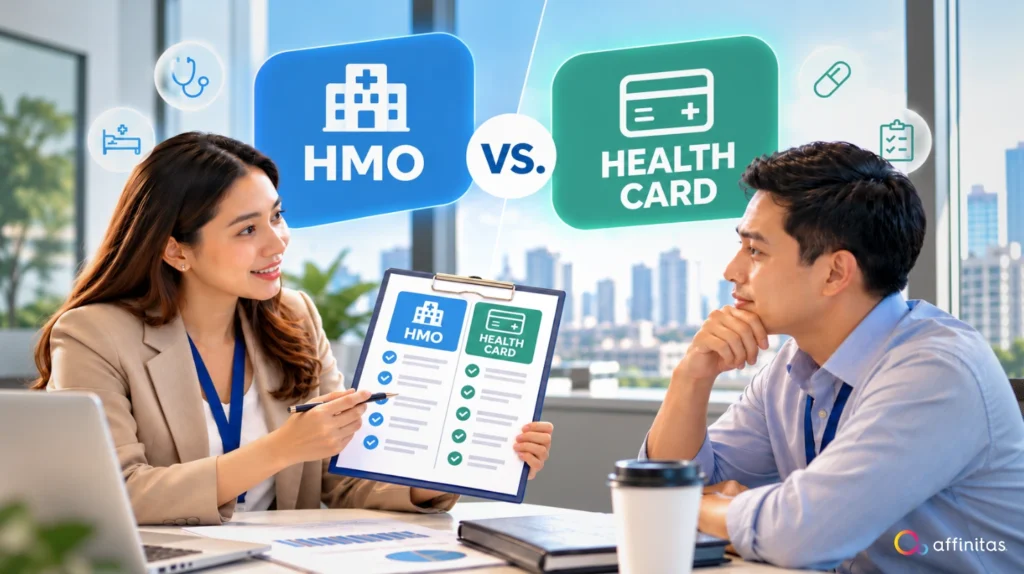
If you have ever tried to compare an “HMO” against a “health card” while building an employee benefits package, you have probably hit a wall of confusing terminology. The two terms get used as if they were rival products, when in reality they describe parts of the same thing.
For HR teams making coverage decisions in 2026, the more useful comparison is between an HMO, standalone health insurance, and government-mandated PhilHealth. Getting that distinction right is what helps you design benefits your people actually use without overspending.
After helping Philippine employers design and manage employee healthcare programs since 2002, one of the most common misconceptions we hear from HR teams is that an HMO and a health card are different products. In reality, the health card is simply the membership card issued by the HMO. The more important decision is choosing the right combination of HMO coverage, PhilHealth, and supplemental insurance based on your workforce and budget.
What People Really Mean by HMO vs. Health Card
The phrase HMO vs. health card usually comes from a simple mix-up. A Health Maintenance Organization, or HMO, is the company that provides your healthcare coverage. The health card is the physical or digital membership card that HMO gives each enrolled employee, the one they tap or present at an accredited clinic or hospital. In other words, the card is proof of your HMO membership, not a competing plan.
So when employees ask whether they should get an HMO or a health card, the honest answer is that they are the same arrangement viewed from two angles. The decision that genuinely affects your budget and your people is choosing the right mix of HMO coverage, supplemental insurance, and the statutory coverage every Filipino worker already has through the government.
How an HMO Works in the Philippines

An HMO operates on a prepaid, network-based model. Your company pays an annual premium per employee, and in exchange, members get largely cashless access to a network of accredited doctors, clinics, and hospitals.
HMOs are licensed and supervised by the Insurance Commission, the same government regulator that oversees life and non-life insurers, which gives employers a layer of accountability when choosing a provider.
Typical HMO coverage includes outpatient consultations, emergency care, hospital confinement, diagnostic tests, and often dental and preventive services. The trade-off is that benefits apply only within the provider’s network and up to a maximum benefit limit per illness or per year. The scale of this market is significant.
The country’s HMO sector paid out around ₱12.10 billion in healthcare benefits and claims in 2025, according to figures the Department of Finance released through the Insurance Commission, which signals just how heavily Filipino workplaces now lean on this coverage.
One consideration employers often overlook is that not all HMOs have the same provider networks, benefit structures, approval processes, or renewal terms. At Affinitas, we help organizations compare these differences so they can select a plan that best fits their employees and long-term healthcare objectives.
Where Standalone Health Insurance Fits In
Health insurance, often sold by life insurers, plays a different role. Instead of network-based prepaid access, it typically pays a defined benefit or reimburses costs for major events such as critical illness, long hospital stays, or permanent disability. It tends to cover larger, lower-frequency expenses that an HMO’s annual limit may not fully absorb.
For most companies, the two work best together rather than as either-or choices. An HMO handles the everyday and the urgent, while supplemental health or group life and accident insurance cushions the high-cost, life-changing events that can otherwise strain both families and company morale.
Why PhilHealth Alone Is Not Enough

Every employed Filipino is already covered by PhilHealth, the national health insurance program, and contributions are mandatory.
In 2026 the premium rate is fixed at 5% of monthly basic salary, split equally between employer and employee, within a salary floor of ₱10,000 and a ceiling of ₱100,000. That coverage is real and valuable, but it is designed as a baseline.
PhilHealth generally subsidizes a portion of inpatient and select outpatient costs rather than the full bill, and it does not match the breadth of routine consultations, diagnostics, and cashless convenience that employees expect from a workplace health plan.
This is precisely the gap an HMO is built to fill, which is why most competitive employers offer one on top of their statutory obligations.
HMO vs. Health Insurance vs. PhilHealth at a Glance
The fastest way to see how these three layers complement each other is side by side. The table below summarizes how each option works, what it typically covers, and the role it plays in a complete benefits package.
| Feature | PhilHealth | HMO (Health Card) | Health Insurance |
| Provided by | Government | Private HMO company | Life or health insurer |
| Required by law | Yes, for all employees | No, optional benefit | No, optional benefit |
| How it pays | Subsidizes part of the bill | Cashless network access | Defined benefit or reimbursement |
| Best for | Baseline coverage | Routine and everyday care | Major or critical events |
| Annual limits | Per-case benefit caps | Per-illness or annual cap | Based on chosen coverage |
What Rising Medical Costs Mean for HR in 2026
The cost backdrop is the single biggest reason coverage decisions deserve real attention this year. Medical inflation in the Philippines has run in the high teens for several years, peaking near 19% in recent surveys from advisory firm WTW.
While the pace is easing slightly, employer healthcare costs in the Philippines are still projected to rise by roughly 14% in 2026, according to consultancy Aon, with chronic conditions like hypertension among the leading claim drivers.
For HR teams, that translates into steeper renewal quotes and tighter benefit limits unless plans are actively managed. Demand is climbing too.
Membership fees collected by HMOs reached ₱26.83 billion in the first quarter of 2026, up nearly 20% year on year, which tells you employers across industries are doubling down on coverage rather than cutting it.
How HR Teams Should Choose in 2026
Choosing the right structure is less about picking one product and more about layering coverage that fits your workforce and your budget. Before your next enrollment or renewal, weigh the following considerations.
-
- Workforce profile. Age mix, job risk, and whether teams are office-based, field-based, or remote all shape which network and benefit limits make sense.
-
- Existing baseline. Confirm PhilHealth compliance first, then design HMO and supplemental coverage to fill the gaps it leaves rather than duplicate it.
-
- Total cost of care. Look beyond the headline premium to utilization data, annual limits, and renewal history so you are not underinsuring or overpaying.
-
- Network fit. A wide provider network is only useful if accredited hospitals and clinics sit near where your people actually live and work.
-
- Room to scale. New hires, dependents, and mid-year changes are easier to manage when your plan and provider support flexible enrollment.
After helping organizations manage employee healthcare programs for more than two decades, we have found that successful healthcare plans are rarely built around the lowest premium alone. Understanding workforce demographics, employee utilization patterns, business growth plans, and provider accessibility often results in better long-term healthcare outcomes and more sustainable benefit costs.
Building the Right Coverage Mix for Your Team
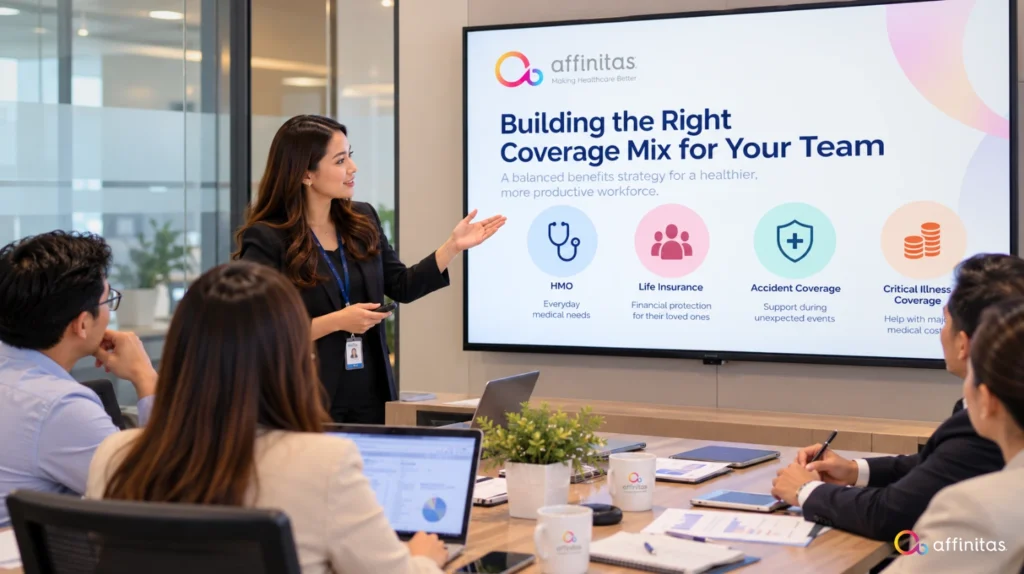
The takeaway is that HMOs, health cards, health insurance, and PhilHealth are not competitors fighting for one slot in your benefits plan. They are layers that work best when combined deliberately. The hard part is matching that mix to your team’s real needs and your cost goals, then negotiating terms that hold up at renewal.
That is exactly where a licensed broker earns its keep. Affinitas compares vetted plans across trusted insurance partners, structures the right blend of employee health plans for your workforce, and stays on call through claims and renewals.
Since 2002, Affinitas has helped organizations across the Philippines design, implement, and manage employee healthcare and insurance programs, including HMO, group life, and other employee benefits solutions
Rather than navigating providers one quote at a time, you get a single partner who works for you, not the insurer. To see what a smarter, right-sized package looks like for your company, talk to an Affinitas broker and request a tailored quote.
Request for a Proposal Today
Send us a message via info@affinitas.com.ph